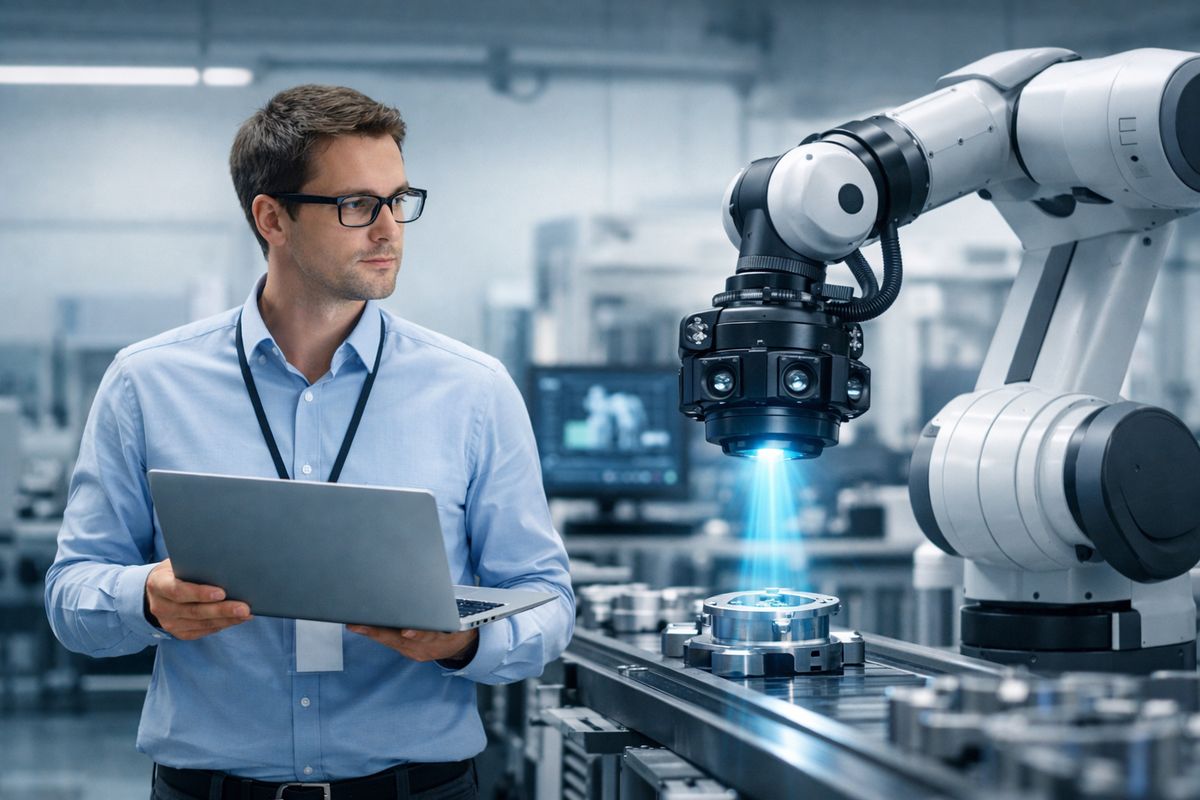
Visual AI is moving from research labs into day to day industrial operations. For manufacturers and industrial SMEs in Greater Barcelona, the question is no longer whether computer vision can create value, but where it fits, what data it needs, and how to deploy it without disrupting production.
Recent attention around teams with advanced AI backgrounds entering industrial vision highlights a broader shift: visual AI is becoming more accessible, more operational, and more relevant to quality, safety, maintenance, and throughput. For business leaders, the real issue is not the technology itself. It is whether a specific use case can deliver measurable operational value.
What visual AI actually means in industrial operations
Visual AI uses cameras and machine learning models to interpret what is happening on a production line, in a warehouse, or at a workstation. In practice, this often means detecting defects, checking assembly steps, monitoring packaging accuracy, verifying labels, identifying anomalies, or supporting safety controls.
That sounds straightforward, but factory deployment is rarely simple. Industrial environments vary in lighting, product mix, line speed, and tolerance thresholds. A model that performs well in a demo can fail in production if the operating conditions are not controlled and the business rules are unclear.
This is why visual AI should be treated as an operational improvement initiative, not just a software purchase.
Where visual AI usually creates value first
The strongest early use cases tend to share three characteristics: repetitive visual checks, costly human inspection, and clear consequences when errors are missed. Examples include defect detection, presence and absence checks, packaging verification, and process compliance monitoring.
Leaders should avoid starting with the most complex possible problem. A better first step is a constrained use case with stable visual conditions and a measurable financial impact. If the defect criteria are vague, the process changes frequently, or the business cannot define what success looks like, the project will struggle regardless of the model quality.
In many plants, the first value does not come from full automation. It comes from reducing false rejects, improving traceability, prioritising manual inspection, or identifying process drift earlier.
Assess data readiness before discussing vendors
Most visual AI projects fail long before model deployment. They fail because the company does not have enough usable image data, cannot label defects consistently, or has not defined the operating process around the model.
Before investing, companies should ask a few basic questions. Do we have representative images across shifts, product variants, and edge cases? Can we define acceptable and unacceptable outcomes in a consistent way? Are cameras already installed, and if so, is the image quality sufficient? Who will validate the model output when it is wrong?
Data readiness also includes governance. If image capture touches workers, visitors, or sensitive production areas, the company needs a clear review of privacy, access control, retention, and security requirements. That is especially important when moving from pilot to scaled deployment.
How to think about ROI without overpromising
Visual AI should be evaluated like any other operational investment. The business case usually depends on a combination of scrap reduction, lower rework, fewer customer complaints, reduced inspection effort, less downtime, or improved throughput.
What matters is not theoretical accuracy in isolation. What matters is whether the system improves a business metric that the plant and management team actually track. A model with high technical performance can still generate weak returns if the use case sits outside the main cost drivers.
For SMEs in Greater Barcelona, a practical ROI discussion should also include implementation overhead. Camera setup, integration with existing systems, process redesign, user training, and model monitoring all carry costs. A disciplined pilot should test not only algorithm performance, but also whether the operating model is realistic at plant level.
What a sensible implementation plan looks like
A strong implementation plan usually starts with a site level diagnostic. The aim is to identify one or two high value use cases, assess data and infrastructure readiness, define success metrics, and map the production workflow around the AI output.
From there, the company can move into a limited pilot. This stage should confirm image quality, data collection methods, decision thresholds, exception handling, and the responsibilities of operators, quality teams, and supervisors. Only after that should the business decide whether to integrate the solution into MES, ERP, or maintenance workflows.
Visual AI also needs ownership. If no one is responsible for retraining triggers, performance drift, and operational feedback loops, the system will degrade over time. That is why implementation should sit within a broader digital strategy, not as a disconnected experiment.
What business leaders should do next
If you are evaluating visual AI for industrial operations, start with a management question, not a technology question: where does visual inspection currently create cost, delay, or quality risk?
Then shortlist use cases using four filters: business impact, process stability, data availability, and ease of operational adoption. Reject projects that depend on unclear defect definitions or major process changes from day one.
Next, run a feasibility assessment before selecting a full solution. Review the line conditions, camera requirements, existing systems, governance needs, and human workflows around intervention and escalation. This prevents expensive pilots that prove technical possibility but not operational viability.
For industrial companies in Greater Barcelona, the opportunity is real, but the winners will be the firms that approach visual AI with discipline. The goal is not to deploy AI because it is new. The goal is to solve a specific operational problem with a system the plant can actually run.