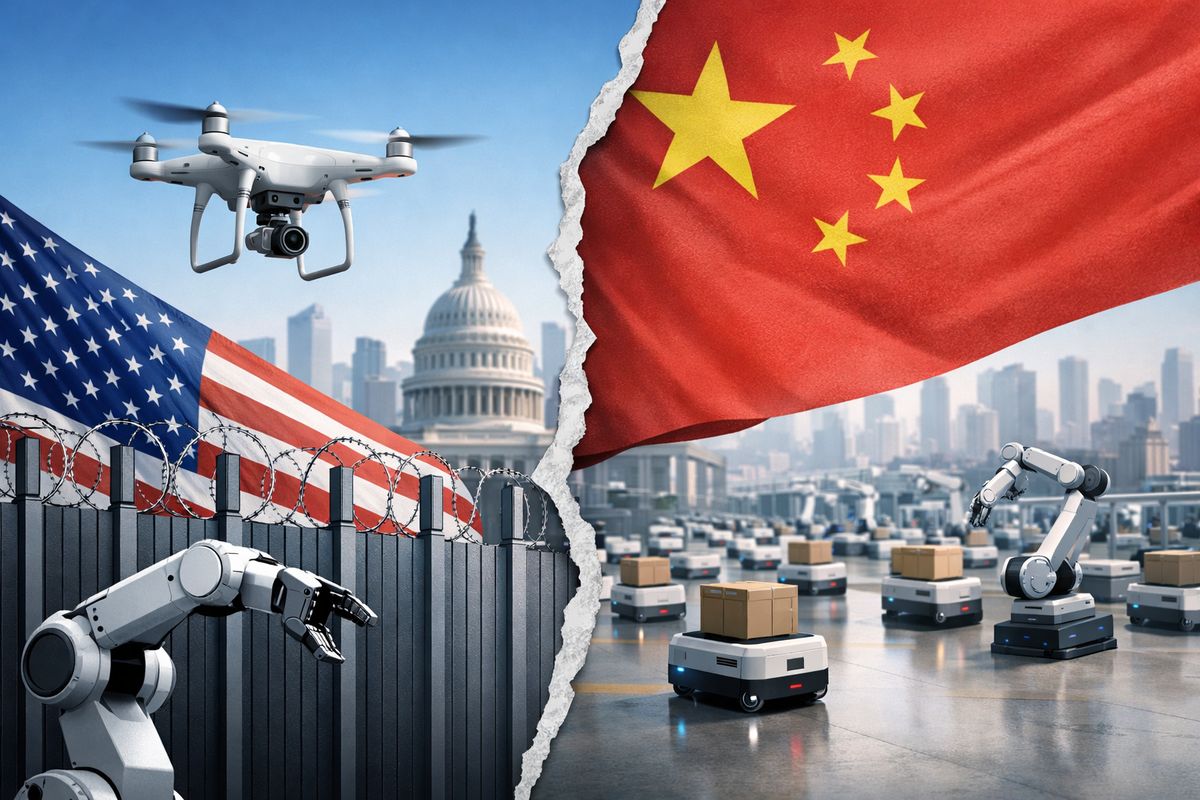
Governments are tightening rules around drones, robotics components, software, and connected industrial systems. At the same time, Chinese manufacturers continue to benefit from production scale, deep supply networks, and the ability to adapt quickly when market access becomes harder. For business leaders, this is not just a geopolitical story. It is a sourcing, compliance, resilience, and investment issue that affects how automation programs should be designed and governed.
Companies planning drone deployments, warehouse robotics, inspection systems, or autonomous equipment need to look beyond unit cost. The real question is how policy friction, supplier concentration, and technology dependence may affect delivery timelines, cybersecurity, maintenance, and long term operating control.
Why this matters beyond the drone sector
Restrictions aimed at drones often signal a broader direction of travel. Once regulators focus on national security, data governance, software control, or critical infrastructure exposure, the same logic can extend to sensors, communications modules, edge devices, navigation systems, and robotics platforms.
That matters for manufacturers, logistics operators, utilities, construction firms, and asset intensive businesses. A procurement decision that looks efficient today can become harder to support tomorrow if spare parts, firmware updates, cloud dependencies, or compliance approvals become uncertain.
China's scale changes the competitive equation
Scale does not remove barriers, but it does change how suppliers respond to them. Large manufacturing ecosystems can redesign products, shift channels, substitute components, or target adjacent markets faster than smaller competitors. That makes simple restriction based strategies less effective than many buyers assume.
For Western companies, this creates a practical challenge. Even when they want to diversify supply, alternatives may be less mature, more expensive, or slower to deploy. The result is a market where risk cannot be managed by policy awareness alone. It requires operational planning and sharper technology governance.
The business risks leaders should assess now
Executive teams should review four areas. First, supplier concentration risk. If one country, platform, or vendor dominates a critical automation layer, the business may be exposed to disruption that is outside its control.
Second, compliance risk. Regulations can change faster than capital cycles. A system approved today may face new restrictions in public sector work, critical sites, or cross border operations later.
Third, cyber and data risk. Connected drones and robots capture location, video, telemetry, and process data. Leaders need clarity on where data is processed, how updates are managed, and who retains technical control.
Fourth, lifecycle risk. Many automation projects fail not at pilot stage but during scaling, support, and renewal. If service tools, replacement parts, or software access become constrained, the initial savings can disappear quickly.
How to structure a more resilient automation roadmap
Businesses should avoid treating robotics procurement as a standalone purchasing exercise. It should sit inside a broader digital strategy that connects technology choices to resilience, governance, operating model, and investment priorities.
In practice, this means mapping critical dependencies before scaling. Identify which components, software layers, and data services are essential to operation. Classify which ones can be replaced, which ones require dual sourcing, and which ones need tighter contractual protection.
It also means designing for substitution where possible. Open interfaces, portable data models, modular architectures, and internal capability for systems integration can reduce lock in. These choices may increase effort upfront, but they create flexibility when regulation or supply conditions change.
What business leaders should do next
Start with a focused review of existing and planned drone or robotics deployments. List vendors, hardware origins, embedded software dependencies, cloud connections, and service arrangements. Then assess where the business is exposed to single points of failure.
Next, separate strategic assets from experimental use cases. Systems tied to safety, critical infrastructure, core logistics, or regulated operations deserve stricter sourcing and governance rules than low risk pilots.
Then create decision criteria for future purchases. Include compliance adaptability, cybersecurity transparency, service continuity, integration flexibility, and exit options alongside cost and performance. If these criteria are not explicit, short term price pressure will usually dominate.
Finally, align procurement, operations, IT, legal, and risk teams early. Most robotics problems emerge between functions, not within them. Cross functional ownership is often the difference between a promising pilot and a scalable operating capability.
A practical shift in mindset
The main lesson for executives is simple. Barriers in global technology markets do not automatically reduce dependence or improve resilience. In many cases, they make supply chains more complex and strategic choices more important.
Companies that respond well will not wait for perfect market clarity. They will build optionality into their automation plans, strengthen governance around connected equipment, and treat robotics as a long term capability decision rather than a narrow sourcing transaction.