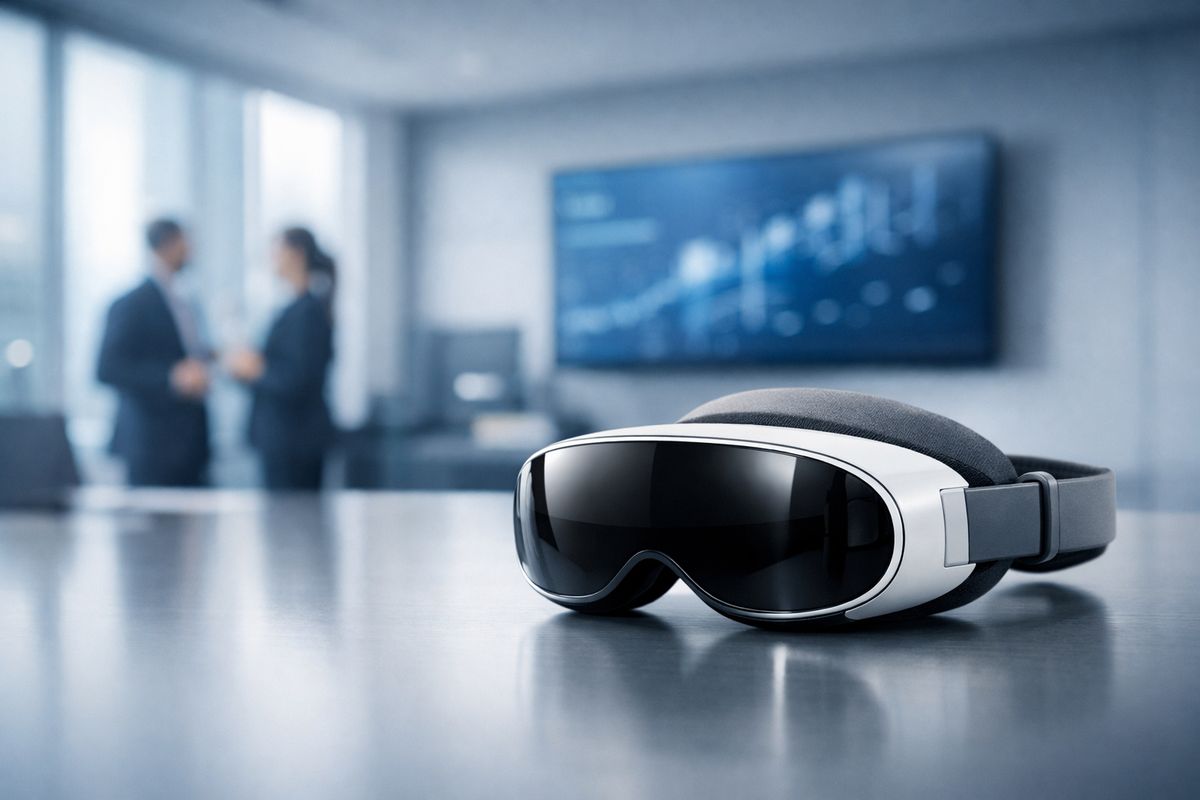
Reports that Meta may have revealed an early look at a slimmer headset are less important for the product image itself than for what it signals to business leaders. The direction is clear: extended reality hardware is moving toward lighter, less intrusive form factors. For companies evaluating immersive tools, that changes the timing, design, and governance of XR decisions.
For CIOs, innovation leaders, and operational managers, the question is not whether one leaked device will succeed. The real issue is whether maturing headset design makes XR more practical for training, remote support, design review, collaboration, and customer experience. That is now a more immediate strategic question than it was a few years ago.
Why a slimmer headset matters to business adoption
Enterprise XR has often faced a basic adoption barrier: people do not want to wear heavy equipment for long periods. If leading vendors are moving toward slimmer headsets, that can improve comfort, reduce friction in onboarding, and make deployment easier outside controlled pilot environments.
For business use, hardware design affects more than employee preference. It influences session length, hygiene procedures, storage, device sharing, IT support, and acceptance by frontline teams. A smaller form factor can make the difference between a demonstration tool and something that fits into daily operations.
The strategic signal behind the product direction
Even when product details remain unofficial or incomplete, design direction matters. It suggests that major platform players believe the next phase of XR growth depends on usability, not just raw technical capability. That is relevant for executives making investment decisions because it points to a shift from experimental technology toward more workable business tools.
Companies should read this as a market maturity signal. Better hardware alone does not create value, but it can remove some of the adoption barriers that previously made XR hard to scale. When hardware friction declines, business model clarity and execution discipline become the main differentiators.
Where enterprise value is most likely to appear
The strongest business cases are still the practical ones. Training remains a priority, especially where repetition, safety, or procedural accuracy matter. Remote expert support is another credible use case when field teams need visual guidance without travel. Product design and engineering teams may also benefit where 3D review shortens feedback cycles.
Customer-facing use cases can be relevant, but they usually require stronger commercial validation. Internal productivity, onboarding, knowledge transfer, and simulation tend to offer a clearer starting point because the performance metrics are easier to define and monitor.
What leaders should not do
Do not treat a new device appearance as a reason to launch a broad XR program without operational logic. Many companies still confuse market visibility with business readiness. A slimmer headset may improve feasibility, but it does not replace process design, content planning, security controls, or change management.
It is also a mistake to wait for a perfect device. Hardware will keep improving. If a use case already has a credible cost, risk, or efficiency problem, the right response is usually structured experimentation rather than passive observation.
How to assess readiness now
Start with business friction, not technology curiosity. Identify one or two workflows where visual immersion could reduce training time, improve consistency, lower support costs, or speed up decision-making. Then assess whether the process has enough repetition and measurable outcomes to justify a pilot.
Next, review the operational constraints. Consider device management, identity and access, data protection, content creation capacity, user support, and integration with existing systems. This is where many pilots fail, not because the headset is weak, but because the surrounding operating model is undefined.
For organisations shaping a broader digital strategy, XR should be assessed as part of a portfolio of transformation tools, not as an isolated innovation topic. That helps leaders compare XR against other investment options using the same business criteria.
What business leaders should do next
Create a simple decision framework. Define the target use case, expected operational benefit, pilot scope, success measures, governance owner, and stop or scale criteria. Keep the first phase narrow. The aim is to learn whether improved hardware design actually changes employee adoption and process performance in your environment.
If the answer is yes, the next step is not immediate expansion. It is standardisation. Build repeatable content, support processes, procurement rules, and security practices before scaling across teams. The organisations that benefit most from XR over the next few years will likely be those that combine selective experimentation with disciplined execution.
Why this development deserves attention now
A slimmer headset is not, by itself, a strategy event. But it is a useful indicator that enterprise XR may be moving closer to practical deployment conditions. For decision-makers, that means this is a good time to revisit old assumptions, refresh pilot criteria, and prepare for a market where immersive tools may become easier to adopt and harder to ignore.