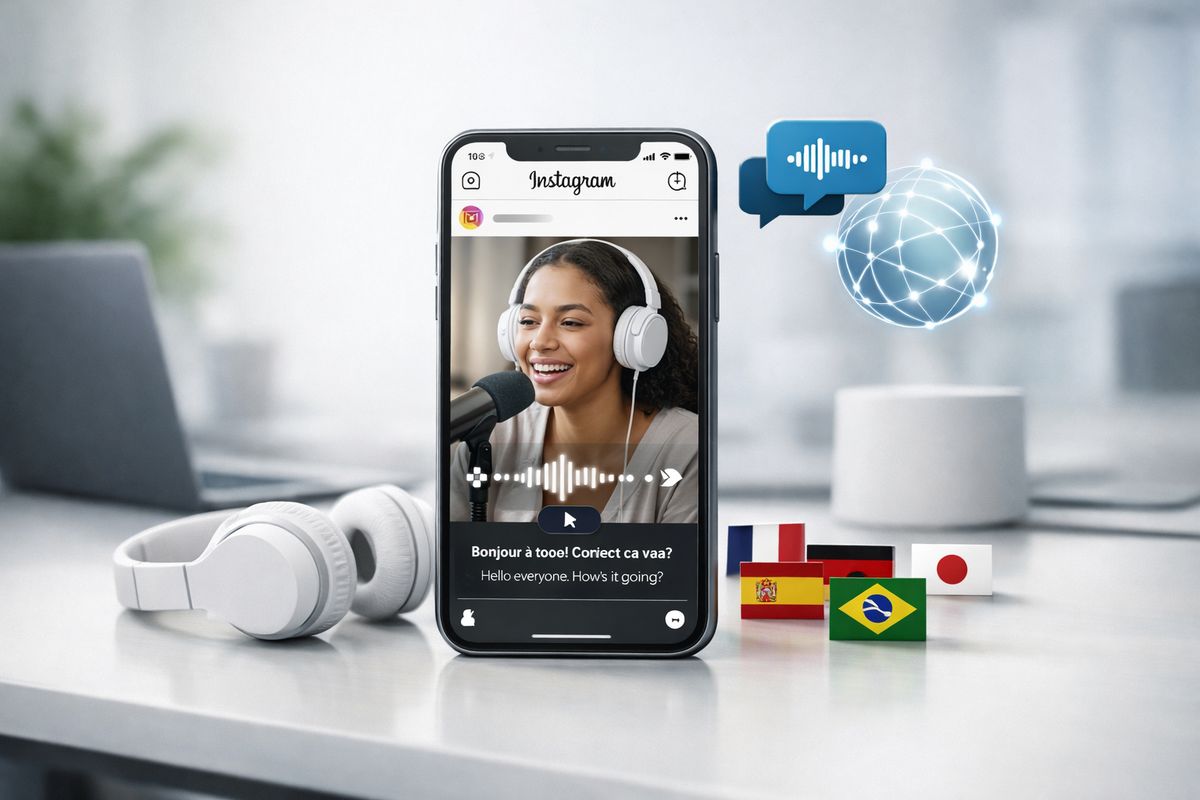
Instagram’s expansion of AI voice translation into French and other languages is more than a product update. For SMEs in the Barcelona area, it signals a practical shift in how multilingual customer communication may work across social platforms. Businesses that rely on Instagram for visibility, enquiries, and community engagement should treat this as part of a broader change in digital customer experience, not as an isolated feature.
The key question is not whether every new AI capability should be adopted immediately. It is whether these tools can reduce friction for customers, support faster content adaptation, and improve communication across language groups without creating operational risk or brand inconsistency.
Why this matters beyond social media
Many companies still treat Instagram as a marketing channel only. In practice, it often sits much closer to sales, service, and reputation management. When a platform adds AI-based language features, it can affect how prospects discover products, understand offers, and interact with a brand.
For businesses serving mixed-language audiences, voice translation can help remove one barrier between content creation and customer understanding. That matters for companies with limited internal resources, especially when teams cannot produce native-language audio or video variants for every market segment.
It also raises a strategic issue. If platforms make multilingual communication easier at the interface level, businesses need to decide where human localisation remains essential and where AI-assisted translation is acceptable.
What business leaders should assess first
Before using AI voice translation in customer-facing content, leaders should review three areas: message sensitivity, brand tone, and process ownership. Not every piece of communication carries the same risk.
Promotional videos, product overviews, event announcements, and simple educational content may be suitable candidates for AI-supported multilingual delivery. Legal statements, regulated claims, pricing details, or high-stakes customer communications usually require tighter review and, in many cases, human validation.
Brand tone is another common weak point. A translated message may be technically correct while still sounding unnatural, overly generic, or misaligned with how the company speaks to customers. That is especially relevant for businesses trying to differentiate on service quality or premium positioning.
Finally, someone must own the workflow. If marketing publishes AI-translated content without clear approval rules, errors can spread quickly across channels.
Where AI voice translation can create practical value
The most immediate benefit is speed. Teams can test multilingual reach without building a fully localised production process for every video or audio asset. This can support faster campaign adaptation, lighter experimentation, and broader content reuse.
There is also a cost and capacity angle. SMEs often face a choice between producing more content in one language or less content in several. AI-supported translation may improve that trade-off, provided quality controls are in place.
For companies in Barcelona that communicate with customers, partners, or audiences across multiple languages, this can be operationally useful. It may help a business validate demand, refine messaging, and identify where deeper localisation investment is justified.
The value is not limited to audience growth. These tools may also help internal teams learn which formats, topics, and messages travel well across language contexts.
The risks companies should not ignore
AI translation can create false confidence. A feature built into a major platform may appear ready for unrestricted use, but platform availability does not guarantee business readiness. Translation quality can vary by context, tone, industry vocabulary, and speaker style.
There is also a governance issue. If content is translated automatically on external platforms, businesses may have less visibility into how meaning shifts across versions. That can affect compliance, customer trust, and performance measurement.
Another risk is fragmentation. If Instagram uses one translation layer, customer support another, and the website a different one, the customer may encounter inconsistent terminology and mixed signals. Over time, this weakens clarity and brand coherence.
How to turn platform features into a workable plan
The right response is not to chase every new AI feature. It is to place them inside a clear digital strategy. That means defining where multilingual communication matters most, which channels influence revenue or service outcomes, and what approval standards apply by content type.
A practical approach is to start with a controlled pilot. Choose one content category, one or two target languages, and a short testing period. Set clear review criteria: linguistic quality, customer response, engagement patterns, and internal effort required.
Keep the pilot narrow enough to manage but broad enough to produce a decision. If the feature improves speed without damaging clarity or trust, it may deserve a wider role. If not, the business still gains a useful rule for future platform adoption.
What leaders should do next
First, audit your current multilingual customer touchpoints across Instagram, other social channels, website content, and customer support. Identify where language friction is most visible.
Second, classify content by risk level. Low-risk content can be tested with AI-supported translation more quickly. High-risk content should stay under stricter human review.
Third, define a simple governance model. Decide who approves translated content, how terminology is maintained, and when legal or commercial validation is required.
Fourth, measure outcomes beyond views. Track whether multilingual content improves enquiry quality, response rates, content reuse, or customer understanding.
Instagram’s voice translation update is best seen as an operational signal. Multilingual AI is moving from specialist tooling into mainstream business platforms. The companies that benefit will not be the ones that adopt it fastest, but the ones that integrate it with discipline.