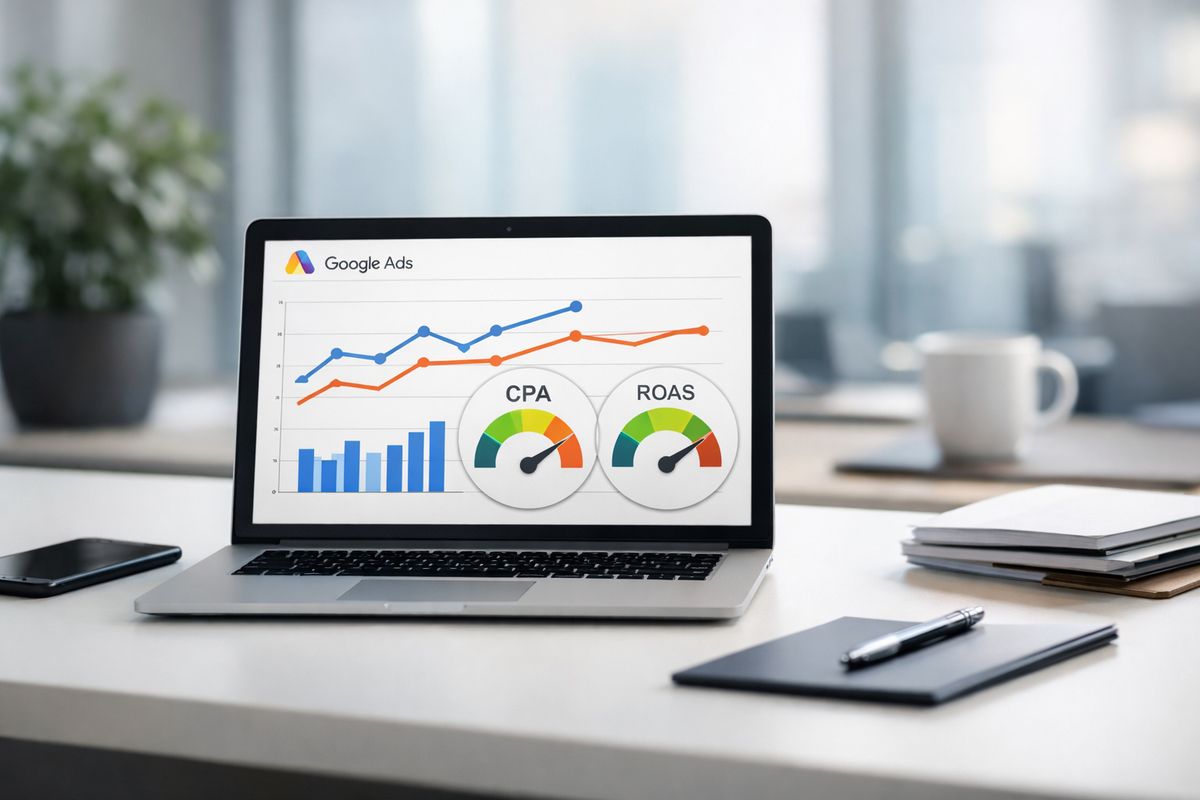
From 17 August, changes affecting Google Ads campaigns using target CPA and target ROAS require closer attention from companies that rely on automated bidding. For SMEs in the Barcelona metropolitan area, this is less about platform news and more about protecting lead costs, sales efficiency, and budget control. If your campaigns depend on stable conversion tracking and predictable bidding, this is a good moment to review how your account is structured and measured.
What is changing in practical terms
When Google updates how target CPA and target ROAS strategies are handled, the main business impact is usually not the label itself but the way bidding logic, campaign settings, and conversion data interact. In practice, companies should expect that campaigns using automated bidding may need cleaner goals, clearer account priorities, and more careful performance monitoring during the transition period.
For decision-makers, the key point is simple: automated bidding only works well when the signals going into it are reliable. If tracking is weak, if multiple conversion actions are mixed together, or if campaign objectives are unclear, CPA and ROAS performance can become harder to interpret and harder to improve.
Why this matters for CPA and ROAS performance
Target CPA and target ROAS strategies are designed to optimise toward a defined business outcome. That makes them powerful, but also sensitive to configuration issues. A change in bidding treatment can expose problems that were already present in the account, such as duplicate conversions, low-quality lead signals, inconsistent attribution, or unrealistic targets.
This matters especially for businesses that report marketing performance to management on a cost-per-lead, cost-per-sale, or return-on-ad-spend basis. If campaign settings no longer align with actual commercial priorities, reported efficiency may look acceptable while real business performance declines.
The main risks companies should review now
The first risk is poor conversion governance. If your campaigns optimise toward actions that do not represent real value, the bidding system may push spend in the wrong direction. A form submission, a phone click, and a qualified sale do not have the same business value, and they should not always be treated the same way.
The second risk is target setting. Many accounts use target CPA or target ROAS levels based on past expectations rather than current economics. If margins, close rates, or average order values have changed, the targets may no longer be realistic. This can limit delivery or distort optimisation.
The third risk is limited observation discipline. During platform changes, reacting too quickly can damage performance further. Companies should monitor trends, but avoid making daily bid target changes unless there is a clear reason supported by data.
A practical review framework for SMEs
Start with conversion actions. Identify which conversions are included in account-level optimisation and decide whether they truly represent business value. Remove or separate low-intent signals where necessary. If lead quality matters more than lead volume, your setup should reflect that.
Then review campaign segmentation. Different products, services, margins, and sales cycles should not automatically sit under the same bidding logic. A blended target often hides major differences in profitability and conversion behaviour.
Next, validate target levels. Ask whether your current CPA target still matches acceptable acquisition cost, or whether your ROAS target reflects real margin constraints. This is a finance and operating model question as much as a media question.
For companies in the Barcelona metropolitan area, this is often the point where local operating realities matter. Multi-language demand, mixed B2B and B2C intent, and uneven lead qualification processes can all affect how well automated bidding performs. The right response is not to overcomplicate the account, but to align bidding with the way the business actually generates value.
What business leaders should do next
Ask for a short audit of bidding, conversion tracking, and campaign objectives before or immediately after the change takes effect. The goal is not a full rebuild unless the account clearly needs one. The goal is to confirm whether the current setup is still fit for purpose.
Management teams should ask five direct questions. Which conversions are driving bidding decisions? Are CPA and ROAS targets tied to commercial reality? Which campaigns generate volume but weak quality? Where is budget being protected, and where is it being wasted? What is the decision rule for intervention if performance becomes unstable?
If those answers are unclear, the issue is not only media buying. It is a governance problem that affects forecasting, reporting, and growth planning.
Use this moment to improve decision quality
Google Ads changes often create short-term uncertainty, but they also create a useful checkpoint. Businesses that treat bidding strategy as part of wider operating discipline usually make better decisions than those that treat it as a technical setting inside the ad platform. A stronger link between measurement, margin logic, and campaign execution will usually matter more than any single platform update.
If your organisation needs to reassess how paid acquisition fits into broader growth priorities, it helps to connect media choices with a wider digital strategy. That creates a more resilient basis for managing CPA, ROAS, and budget allocation over time.