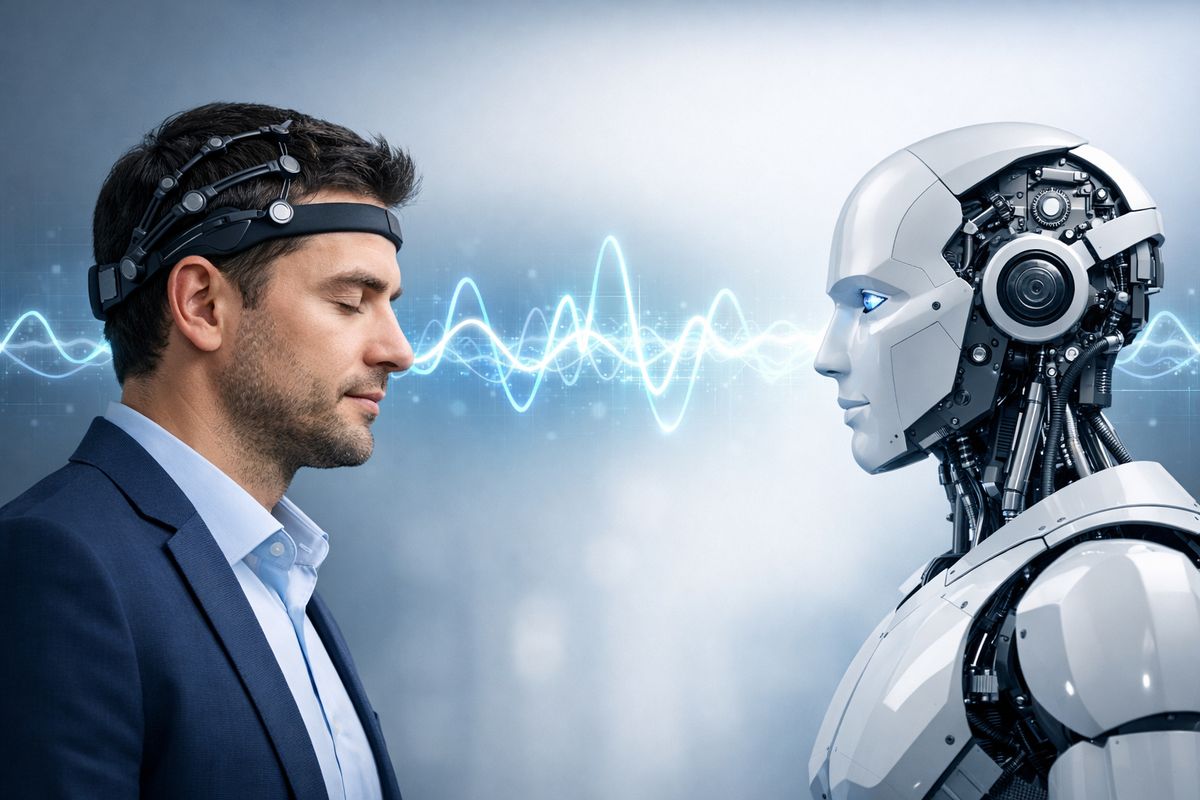
Brain wave interfaces are attracting attention as companies explore the next generation of physical AI. The core idea is simple: if machines can interpret human intent more directly, they may become faster, safer, and easier to control in real-world environments. For business leaders, the real question is not whether brain signals will replace screens, keyboards, or industrial controls. It is whether this emerging capability could create practical value in robotics, assistive systems, advanced manufacturing, logistics, healthcare technology, or high-risk operations.
That makes this topic less about science fiction and more about strategic timing. Most organizations do not need a brain-computer interface program today. But many should start tracking where human intent detection, adaptive control, and physical AI are beginning to overlap.
What brain waves could add to physical AI
Physical AI refers to systems that act in the real world: robots, autonomous equipment, smart prosthetics, industrial machines, and other devices that sense, decide, and move. Brain signal input could add a new control layer to these systems by helping them detect user intent, cognitive load, attention, or stress.
In business terms, this matters where conventional interfaces create friction. A worker controlling complex equipment, a surgeon using assistive robotics, or an operator managing machines in hazardous conditions may benefit if a system can respond to intention with fewer manual inputs. In some use cases, brain signals may not become the primary interface. They may instead serve as a secondary signal that improves safety, precision, or responsiveness.
Where the business opportunity is real
Executives should focus on narrow, high-value use cases rather than broad claims about mind-controlled machines. The strongest early opportunities are likely to appear where physical tasks are difficult, hands-busy, safety-critical, or highly personalized.
Examples include assistive technologies, rehabilitation devices, robotic support for repetitive tasks, training systems that adapt to operator attention, and control environments where reducing reaction time matters. Another area to watch is human-in-the-loop robotics, where AI does not fully replace human judgment but augments it with faster interpretation and machine execution.
The opportunity is not just better interfaces. It is better system design. If human intent data can improve how machines collaborate with people, companies may redesign workflows, safety controls, and service models around that capability.
Why caution matters more than headlines
Brain wave technologies still face serious limitations. Signal quality can be inconsistent. Hardware can be intrusive or uncomfortable. Training requirements may be significant. Interpretation models can be fragile outside controlled environments. Integration with existing systems is also complex, especially where safety, reliability, and liability matter.
There is also a governance challenge. Brain-related data is sensitive. Even when the technology only captures high-level intent signals, organizations must think carefully about privacy, consent, cybersecurity, access control, and acceptable use. For any company considering this field, the ethical and operational design questions arrive early, not later.
That is why leaders should be skeptical of broad transformation claims. In the near term, the most credible path is targeted experimentation tied to measurable operational problems.
How to evaluate whether this matters for your business
A practical starting point is to identify where human-machine interaction is already a bottleneck. Look for tasks where users need both hands, where reaction speed matters, where fatigue affects outcomes, or where physical interfaces slow down decisions. Then ask a narrower question: would another layer of intent sensing improve performance, safety, or usability?
For most organizations, this is a strategic assessment problem before it is a technology procurement decision. That is why it should sit within a broader digital strategy, alongside automation priorities, AI governance, data architecture, cybersecurity, and operating model design.
Leaders should also separate three horizons: what is commercially usable now, what is promising but immature, and what is still research-led. Mixing those horizons is one of the fastest ways to waste budget.
What business leaders should do next
First, assign ownership. Emerging interfaces often fall between innovation, IT, operations, product, and compliance teams. Without clear ownership, they remain interesting but untested.
Second, define use cases with operational discipline. Focus on one environment, one user group, and one measurable problem. Examples could include reducing operator input complexity, improving assistive control accuracy, or increasing safety in a specific workflow.
Third, assess constraints early. Review data sensitivity, hardware practicality, integration complexity, workforce acceptance, and legal exposure before launching pilots.
Fourth, design small experiments. A good pilot should test feasibility, usability, reliability, and business relevance, not just technical novelty. If the business case depends on ideal conditions, the use case is probably not ready.
Fifth, monitor adjacent developments. Even if direct brain-computer interfaces remain niche in the short term, the broader field of human intent sensing will keep advancing through wearables, computer vision, biosignals, and multimodal AI interfaces. Those may reach commercial value faster than pure brain wave systems.
The strategic takeaway
Brain waves may become one of several inputs that help physical AI work more naturally with humans. That does not mean a universal breakthrough is around the corner. It means some industries should begin preparing for a future in which machine control, human intent, and adaptive AI become more tightly connected.
The winners will not be the companies that chase the most futuristic story. They will be the ones that identify a real operational problem, evaluate the interface options pragmatically, and test where human-centered physical AI can create measurable value.