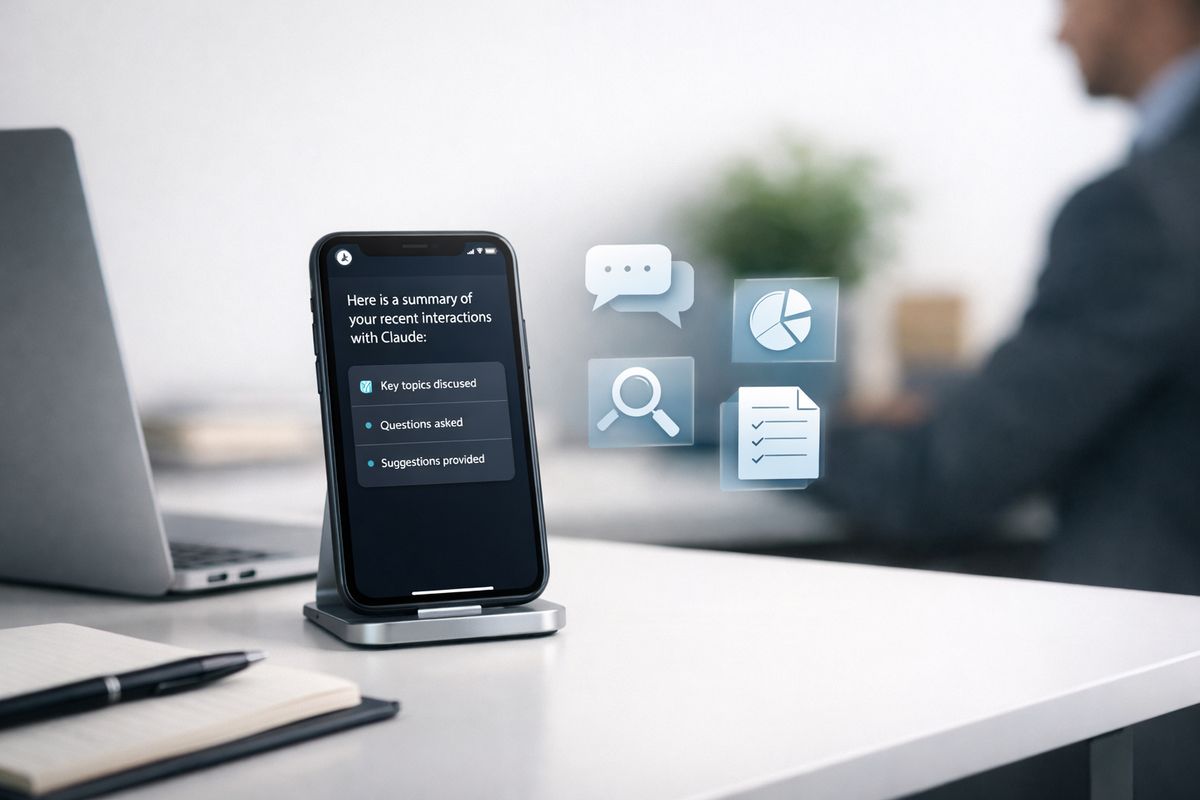
Anthropic’s Reflect feature points to a broader management question that matters beyond any single AI platform: how should a company review its actual AI usage over time? For SMEs in the Barcelona area, this is less about product news and more about operational discipline. If teams are already using tools like Claude, Copilot, ChatGPT, or internal assistants, leadership needs a structured way to understand what is being used, where value is emerging, and where governance is still weak.
An AI retrospective is a practical way to do that. It turns scattered prompts and informal habits into a reviewable workflow. Done well, it helps companies improve adoption, reduce avoidable risks, and identify where AI should be integrated into everyday operations rather than left as an individual experiment.
What an AI usage retrospective actually means
A retrospective is not just an activity log. It is a management review of how people are using AI, for which tasks, with what level of consistency, and under which controls. The goal is not surveillance. The goal is to create visibility that supports better decisions.
For most SMEs, four questions matter: which teams are using AI regularly, which use cases are repeated often enough to deserve standardization, where outputs still require too much rework, and where sensitive information or weak prompting practices create avoidable exposure.
This is why a usage retrospective matters. Without it, management often sees AI only through anecdotes. One team says it saves time. Another says results are unreliable. A retrospective provides enough structure to move from opinion to operational assessment.
Why business leaders should pay attention
Many companies adopt AI from the bottom up. Individuals test tools first, then departments follow, and only later does leadership try to impose policy. This sequence is common, but it creates fragmented practices. Different teams may use different tools, different prompt styles, and different review standards for similar work.
That fragmentation has business consequences. Quality becomes inconsistent. Knowledge stays with individuals instead of becoming a repeatable method. Risk controls lag behind actual usage. Training remains generic because nobody has mapped which workflows are already influenced by AI.
A retrospective helps leadership answer a more useful question than “Are people using AI?” The better question is “Where is AI already changing work, and what should we formalize next?” That is the point where experimentation becomes management.
Where retrospectives create value for SMEs
The strongest use cases are usually not the most impressive ones. They are the repeated, operational tasks where teams spend time every week. Examples include summarizing meetings, drafting routine communications, structuring research notes, preparing first versions of proposals, supporting customer service responses, or organizing internal documentation.
When these activities appear repeatedly in AI logs or retrospectives, they are candidates for standard operating practices. This is where AI shifts from personal productivity to business capability. A company can then define approved prompts, review criteria, escalation rules, and expected output formats.
For companies working on efficiency priorities, this is closely linked to process optimization. The retrospective shows where AI is already affecting workflow, and that makes it easier to redesign steps, remove duplication, and set clearer ownership.
What to review in an AI activity log
Business leaders do not need a forensic audit. They need a simple review model that can be repeated monthly or quarterly. Start with use case categories, frequency of use, user groups, and business criticality. Then review whether the work is exploratory, semi-structured, or mature enough to document formally.
It is also important to check output quality and review burden. If a task is generated quickly but still needs extensive correction, the productivity gain may be weaker than it appears. If a use case consistently produces acceptable first drafts, it may be ready for broader deployment.
Governance should also be part of the review. Look at whether staff may be entering confidential information, whether prompts are reusable and understandable, whether there is a human validation step, and whether responsibilities are clear when AI-generated content is used externally.
How Barcelona area SMEs can turn AI usage into governance
In the Barcelona business context, many SMEs are balancing growth, resource constraints, multilingual operations, and the need to professionalize internal processes without adding heavy bureaucracy. That makes AI retrospectives especially useful. They offer a lightweight governance mechanism that can fit smaller organizations without requiring a large transformation program.
The practical approach is to start with one function or one recurring workflow, not the whole company. For example, a management team might review how commercial, operations, or support staff are already using AI in weekly work. The objective is to identify repeatable patterns, define acceptable usage, and clarify where human approval remains mandatory.
This creates a more credible adoption path than broad AI policy documents alone. Teams understand what is permitted, managers see where value is real, and the company builds governance from observed practice rather than theory.
What leaders should do next
First, appoint an owner for the retrospective. This does not need to be a new full-time role, but someone must coordinate the review and translate findings into action. Without ownership, usage visibility rarely turns into operational change.
Second, define a short review cadence. Monthly is often enough at the beginning. Track the main use cases, the teams involved, quality issues, and any governance concerns. Keep it simple enough that the process survives beyond the first month.
Third, select two or three use cases that deserve formalization. Document the purpose, the prompt approach, the review step, and the expected output. This is where experimentation becomes a managed workflow.
Fourth, update training based on observed usage, not generic AI awareness. If teams are already using AI for drafting, summarization, or knowledge retrieval, train them on those exact tasks. This is far more useful than broad theoretical sessions.
Finally, use the retrospective to support decision-making. It should help leadership choose where to scale, where to restrict, and where to redesign work. That is the real strategic value of AI activity review: not more reporting, but better operational choices.