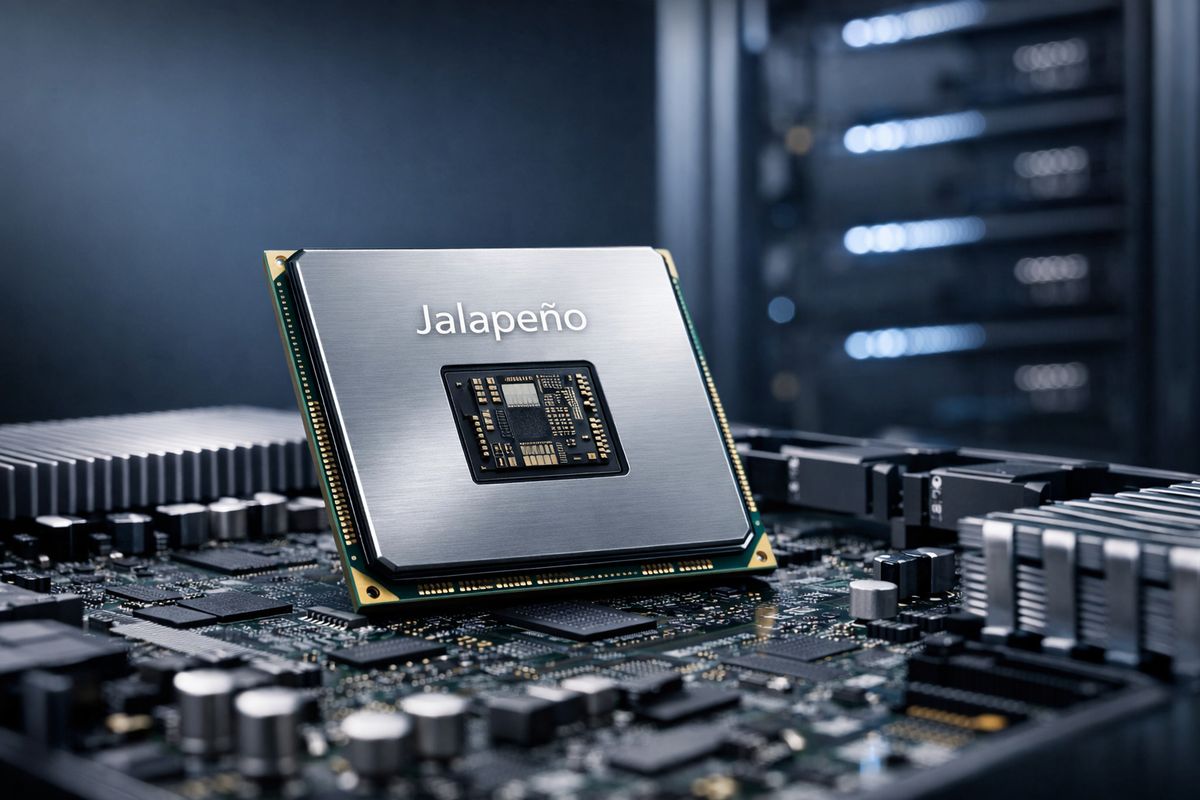
New benchmark discussions around OpenAI's reported Jalapeño chip point to a business issue that matters far beyond chip design: fast AI inference at scale is becoming a competitive operating capability. For business leaders, the question is not whether a specific processor wins a headline benchmark. The real question is how inference performance, cost, latency, and deployment flexibility should influence AI investment decisions.
Many organisations focused first on model experimentation. They are now entering a more demanding phase where AI must support real workloads, real users, and real service levels. That shift makes infrastructure choices much more important than they appeared during early pilots.
Why inference matters more than many companies expect
Training a model attracts attention because it is technically complex and expensive. Inference is where the model creates value repeatedly in day-to-day operations. Every customer interaction, document analysis, recommendation, forecast, or internal assistant request depends on inference capacity.
If inference is too slow, too expensive, or too difficult to scale, AI use cases can stall even when the model itself performs well in testing. This is why new chips designed for high-throughput inference are attracting attention. They suggest a market direction in which the economics of serving AI at production scale may improve for some workloads.
What business readers should take from benchmark headlines
Benchmarks can be useful, but they rarely answer the questions executives actually need answered. A chip can perform strongly in a controlled test and still be the wrong choice for a business environment. Leaders should treat benchmark news as an indicator of technological direction, not as a procurement decision.
The practical issues are broader: which models the hardware supports, how easily it integrates with existing cloud or on-premise environments, how stable the software stack is, what utilisation rates are realistic, and whether the total operating cost improves business margins. Speed alone is not the decision criterion. Predictability, governance, and deployment fit often matter more.
How faster inference changes the business case for AI
When inference improves, several business options become more realistic. Customer-facing AI can respond fast enough for service environments. Internal copilots can support larger teams without creating unacceptable cost spikes. Automation can move from batch processing to near real-time decisions. These changes affect both revenue opportunities and operating models.
For CIOs and operations leaders, this means AI infrastructure should be reviewed as part of portfolio planning, not treated as a narrow engineering matter. In many cases, the strongest business value comes from matching each use case to the right performance and cost profile rather than standardising too early on a single platform.
The infrastructure questions leaders should ask now
Before reacting to any single chip announcement, decision-makers should examine their own inference demand. Which use cases are already in production? Which are likely to scale in the next 12 to 24 months? What latency is acceptable for each one? What level of accuracy is necessary, and where can smaller or more efficient models be used?
They should also ask whether current architecture choices are creating hidden inefficiencies. Many organisations are paying for general-purpose infrastructure when their production needs would benefit from more specialised AI serving options. Others are still running pilots without a clear path to cost control. This is where a structured digital strategy becomes important, connecting infrastructure decisions to operating priorities, governance, and expected business outcomes.
Where specialised AI chips fit in an enterprise roadmap
Specialised inference chips are unlikely to eliminate the need for a mixed environment. Most enterprises will continue using a combination of cloud services, standard accelerators, managed model platforms, and in some cases specialised hardware. The right mix depends on regulatory constraints, workload variability, internal engineering maturity, and procurement strategy.
For many companies, the near-term opportunity is not to bet on a single hardware winner. It is to build enough architectural flexibility to adopt better inference economics as the market matures. That includes avoiding lock-in where possible, defining measurable service requirements, and designing applications so model and infrastructure components can evolve without full rework.
What business leaders should do next
Start with a practical review of your top AI use cases. Group them by latency sensitivity, volume, business criticality, and data constraints. Then compare your current serving model against those requirements. This often reveals where premium infrastructure is justified and where lower-cost deployment options are sufficient.
Next, establish a clear decision framework for AI infrastructure. Include unit economics, operational resilience, security, integration effort, and vendor dependency alongside raw performance. Finally, treat inference capability as a strategic operating layer. As AI adoption expands, the organisations that manage inference well will be better positioned to scale value, control cost, and move faster than competitors still focused only on model selection.