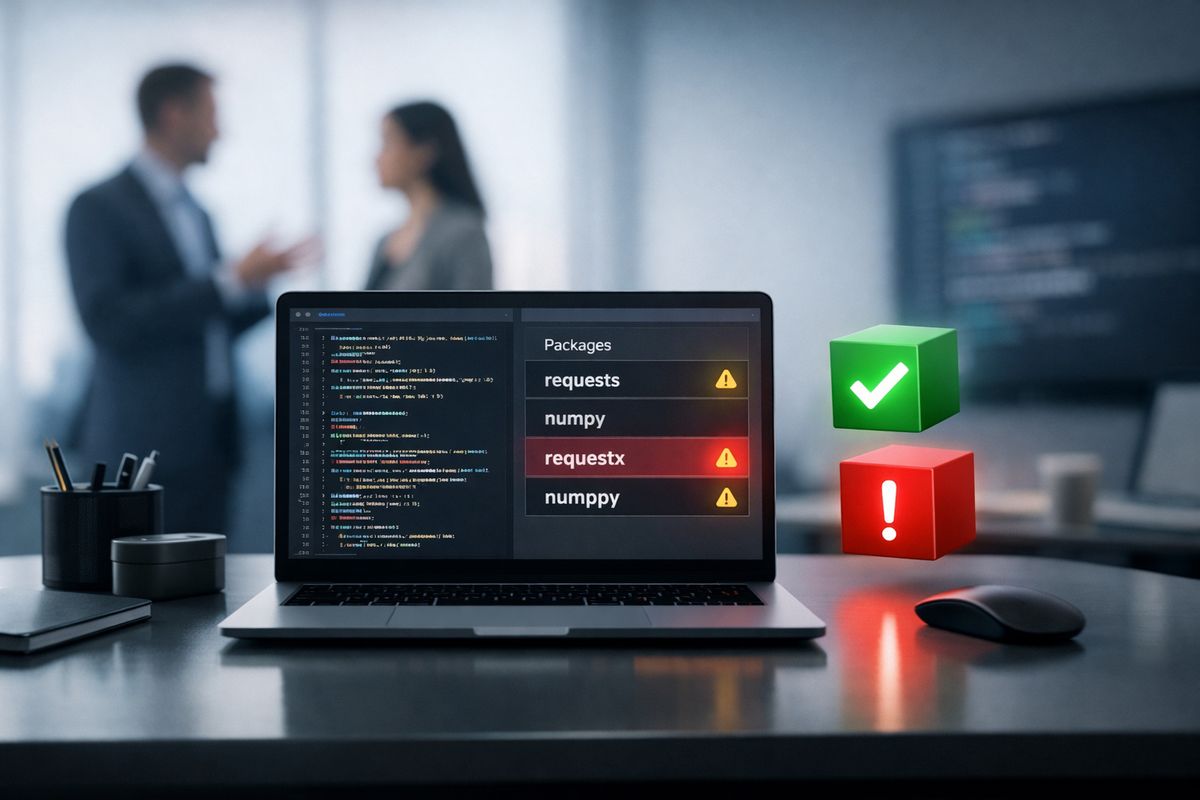
AI coding tools can speed up delivery, but they also introduce a newer software supply chain risk: developers may accept package names, libraries, or dependencies suggested by AI that do not exist in trusted registries or do not belong in the project. Attackers can then publish malicious packages under those names and wait for someone to install them. This pattern is often called slopsquatting. For SMEs in the Barcelona metropolitan area, the issue is not theoretical. Any team using code assistants, rapid prototyping tools, or automated dependency workflows should treat this as a practical governance and security problem.
What slopsquatting actually means
Traditional typosquatting relies on human typing mistakes. Slopsquatting is different. It exploits AI-generated mistakes. A coding assistant may suggest an incorrect package name, a non-existent open source library, or an import that looks plausible but has no verified origin. If a developer trusts the suggestion and installs it, an attacker can take advantage by publishing a package with that exact name.
The risk sits at the intersection of AI adoption, developer productivity pressure, and weak dependency controls. It matters because the attack can enter through normal development activity rather than an obvious phishing attempt or direct breach.
Why business leaders should pay attention
This is not just a developer hygiene issue. It affects operational continuity, client trust, regulatory exposure, and delivery quality. If a malicious dependency reaches an internal tool, customer-facing application, or integration workflow, the impact can spread quickly across environments.
For leadership teams, the underlying problem is governance. Many organisations have approved AI tools informally, without clear rules for code review, dependency validation, or procurement of external components. The result is a mismatch: faster coding on one side, unchanged risk controls on the other.
Where SMEs are most exposed
Smaller firms are often more exposed because they move quickly and rely on lean teams. Common weak points include prototype code being promoted into production, limited review of third-party packages, shared admin rights in repositories, and no documented policy for AI-generated code.
In the Barcelona metropolitan area, many SMEs are balancing digital growth with limited in-house security capacity. In that context, AI-assisted development can create hidden supply chain exposure unless basic controls are defined early and reviewed regularly.
A practical checklist for an AI-driven supply chain risk review
Map where AI coding tools are being used. Identify which teams, contractors, and projects use code assistants, copilots, prompt-based generators, or auto-complete tools. If you do not know where AI contributes to code, you cannot assess the risk.
Review dependency approval rules. Define who can add new packages, from which registries, and under what review process. Unverified or first-time dependencies should trigger extra checks.
Require validation of suggested libraries. Developers should confirm that any package proposed by AI actually exists, is maintained, and is appropriate for the task before installation.
Strengthen code review for AI-generated changes. Reviews should cover imports, package manifests, build scripts, and installer commands, not just application logic.
Restrict direct installation from unknown sources. Limit the ability to pull packages from unapproved registries or ad hoc sources in development and CI pipelines.
Monitor software bills of materials and dependency changes. Even a lightweight inventory is better than none. Visibility helps teams spot unexpected new components quickly.
Test incident response on the development side. If a malicious package is discovered, the team should know how to isolate systems, rotate secrets, review impacted builds, and communicate internally.
Controls that matter more than tool promises
Buying an AI coding tool from a reputable vendor does not remove the need for internal controls. The key question is not whether the tool is advanced, but whether your operating model can detect and stop unsafe suggestions before they become deployed software.
Useful controls include approved package lists for critical projects, branch protection, mandatory peer review, automated dependency scanning, registry restrictions, and documented secure development standards. These are management decisions as much as technical ones.
What leaders should do next
Start with a short cross-functional review involving IT, engineering, operations, and management. The goal is to answer three questions: where AI is already shaping code, how dependencies are currently controlled, and what would happen if a malicious package entered a live workflow.
If the answers are unclear, that is already a finding. A structured digital audit can help establish a baseline across tools, processes, responsibilities, and supply chain controls. For SMEs, this is often the fastest way to separate manageable risk from unmanaged exposure.
The immediate priority is not to stop using AI. It is to use it with rules that match its real risk profile. Organisations that put those rules in place early are better positioned to gain productivity without weakening their software supply chain.